

Supply chains have never had more technology at their disposal – AI, real-time sensing, autonomous systems, connected data. And that technology is only going to matter more.
But for decades, supply chain excellence came down to a simple equation: cost + efficiency + service. That equation is now shaped by geopolitical fragmentation, climate disruption, regulatory complexity and AI acceleration – and it’s exposing a gap.
The question isn’t “which technology should we implement?” anymore. It’s “what capabilities do we need to actually get value from it?”
The evidence already backs this up.
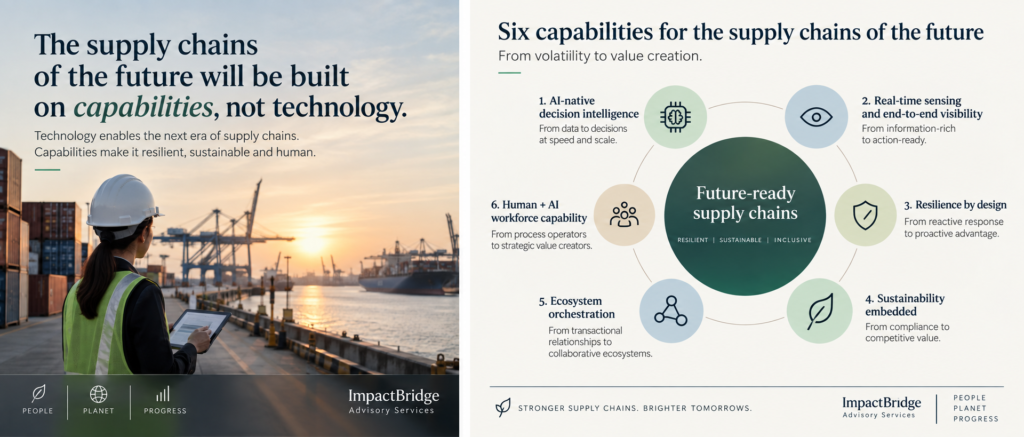
Here are six capabilities that matter most going into 2026 – and the results companies are getting from them.
1. AI-native decision intelligence
Most companies are still piloting AI, not scaling it. McKinsey’s 2025 supply-chain survey found three-quarters of companies planning, blueprinting or piloting AI use cases – but only 19% had deployed AI at scale. BCG’s 2026 supply-chain planning research confirms why: “most value today comes from foundational applications – improving forecasting, exception management, data interpretation and workflow automation – rather than from lights-out planning,” and the gap between AI leaders and laggards is widening, not closing.
Case Example: Unilever shows what the leaders look like. Its AI-enabled Customer Operations team has delivered over €1.7 billion in value in two and a half years by improving service levels, cutting inventory and lifting efficiency – while sharing forecasting data directly with retail partners including Amazon, Walmart and Tesco. In India, a Deloitte-FICCI study cited by Business Today found FMCG and retail firms already deploying AI across demand forecasting, inventory management, pricing and supply chain resilience, as India’s consumer economy heads toward $1.9 trillion by 2030.
2. Real-time sensing, not just visibility
Gartner’s research puts the execution gap starkly: 95% of supply chains need to react quickly to change, but only 7% can execute decisions in real time. Visibility without the ability to act just creates organizations that are information-rich and action-poor — the real capability stack is sense → decide → act, not measure → report.
Case Example: Progress is real but uneven. PwC’s decarbonization research (via ESG Today) found 75% of companies now have visibility beyond tier-1 suppliers, up from just 50% in 2023 — meaningful gains, but a quarter of companies still can’t see past their first layer. In pharma, where the stakes of losing visibility are measured in spoiled cold-chain shipments, Johnson & Johnson has backed a $55 billion initiative to manufacture advanced medicines domestically in the U.S. and streamline its supply network, while industry analysts note that “visibility alone does not guarantee reliability” without the systems to act on what it shows.
3. Resilience by design
Resilience has become a growth strategy, not just risk mitigation. The World Economic Forum’s Global Value Chains Outlook 2026 found 74% of business leaders view resilience as a driver of growth, describing an era of “structural volatility” driven by geopolitics, industrial policy and the energy transition.
Case Example: McKinsey’s 2025 research shows how companies are actually responding to disruption: 45% increasing inventory, 39% dual sourcing, and 33% pursuing nearshoring or onshoring. J&J’s $55 billion U.S. manufacturing push – alongside up to $750 million in related restructuring costs – is a live example of a pharmaceutical major rebuilding its network for resilience rather than just efficiency, even as quarterly sales grew 6.6% through the transition.
4. Sustainability embedded, not bolted on
Sustainability is moving from the reporting function into the operating model. Gartner reports that 67% of supply chain leaders name the volume of new ESG regulation as one of their top five influential drivers over the next three to five years, and Deloitte’s 2025 C-suite Sustainability Report – 2,100+ executives across 27 countries – found sustainability remains a top-three C-suite priority alongside technology and AI.
Case Example: The scale of the challenge is real: Scope 3 emissions make up roughly 90% of a typical company’s carbon footprint and run about 26 times higher than direct operational emissions, yet EcoVadis research finds only 10% of companies can accurately measure them. But the results are also real. Walmart’s Project Gigaton mobilized more than 5,000 suppliers – including Dell, Diageo, General Mills and Kellogg – to cut over 1 billion metric tons of greenhouse gas emissions from its supply chain, hitting 2030 target six years early. PwC’s research shows the wider shift: 76% of companies now set supplier decarbonization requirements, up from 51% just two years ago, and Scope 3 disclosures rose 30% year-over-year.
5. Ecosystem orchestration
No company decarbonizes its supply chain, fixes labor practices, or builds circularity alone – Walmart’s emissions win only happened because it orchestrated action across an ecosystem of 5,000+ suppliers, not because it acted inside its own four walls. Gartner’s 2026 Supply Chain Top 25 highlights end-to-end supply orchestration as a defining trait of leading organizations, and McKinsey’s 2025 CPO research identifies supplier collaboration and co-innovation as a top theme for procurement leaders.
Case Example: Unilever’s approach is a working example: rather than managing retail partners transactionally, it now shares forecasting and inventory data directly with Amazon, Walmart and Tesco to keep products available and reduce waste across the network – collaboration, not just compliance.
6. A redesigned human + AI workforce
AI won’t just change tasks – it will change how work is divided between people and machines. Demand for supply-chain roles requiring AI skills grew 387% between Q1 2023 and Q1 2026 – far outpacing broader labor-market growth. The traditional career ladder, built on years of repetitive transactional work, is being replaced by faster paths into exception management, scenario planning, AI supervision and supplier relationship management.
Case Example: Gartner’s 2026 research found 55% of supply chain leaders expect agentic AI to reduce the need for entry-level hiring, while 86% believe adoption will require entirely new processes for developing future talent pipelines.
The warning
Technology does not automatically create capability. Companies that try to leapfrog straight to autonomous AI without stable planning foundations tend to struggle; those that layer AI deliberately onto solid processes see durable gains.
PwC’s 2025 Digital Trends in Operations Survey of 610 operations and supply chain leaders found 92% said their technology investments had not fully delivered expected results – even though 57% had already integrated AI into selected functions or across the organization. BCG’s 2026 research points to the same root cause: performance differences come down to “how effectively organizations have embedded the new tools in their decision-making processes,” not whether they bought the tools at all.
Where to start
- Build an AI-ready data foundation before scaling use cases
- Map dependencies beyond tier-1 suppliers
- Build scenario-planning muscle for real shocks
- Embed sustainability into the decision architecture, not an approval layer
- Redesign roles around AI, resilience and sustainability skills
The future belongs to organizations that don’t just have the most AI pilots or the biggest dashboards – but the most capability density: the ability to sense, decide, collaborate and act as one system.
That’s the shift we help supply chain and sustainability leaders navigate at ImpactBridge.
Sources
- McKinsey & Company, “Global Supply Chain Leader Survey 2025” – https://www.mckinsey.com
- BCG, “Supply Chain Planning 2026: Why AI Alone Isn’t Enough” – https://www.bcg.com/publications/2026/supply-chain-planning-why-ai-alone-isnt-enough
- Unilever, “Using AI in Supply Chains to Elevate the Customer Experience,” 2025 – https://www.unilever.com/news/news-search/2025/using-ai-in-supply-chains-to-elevate-the-customer-experience/
- Business Today, “India Tops Global AI Adoption Race… (Deloitte-FICCI),” Aug 2026 – https://www.businesstoday.in/technology/artificial-intelligence/story/india-tops-global-ai-adoption-race-as-retailers-fmcg-firms-deploy-technology-across-operations-deloitte-ficci-547072-2026-08-04
- Gartner, 2026 Supply Chain Technology Trends and Supply Chain Top 25 – https://www.gartner.com
- PwC / ESG Today, “82% of Companies Maintaining or Accelerating Climate Goals…” – https://www.esgtoday.com/82-of-companies-maintaining-or-accelerating-climate-goals-as-decarbonization-efforts-extend-to-supply-chain-pwc/
- BioSpace, “Amid $55B US Manufacturing Push, J&J Turns to Streamlining Its Pharma Supply Chain,” 2026 – https://www.biospace.com/business/amid-55b-us-manufacturing-push-j-j-turns-to-streamlining-its-pharma-supply-chain
- Supply Chain Dive / ESG Dive, “Walmart Hits Supplier Emissions Goal 6 Years Early” — https://www.supplychaindive.com/news/walmart-project-gigaton-scope-3-supplier-emissions-6-years-early/708192/
- EcoVadis, “What Is Supply Chain Sustainability: Key Trends in 2026” — https://ecovadis.com/blog/supply-chain-sustainability/
- World Economic Forum, Global Value Chains Outlook 2026 — https://www.weforum.org
- Deloitte, 2025 C-suite Sustainability Report — https://www.deloitte.com
- Logistics Viewpoints, “Pfizer and the Broader Push to Improve Cold Chain Visibility,” 2026 — https://logisticsviewpoints.com/2026/06/02/pfizer-and-the-broader-push-to-improve-cold-chain-visibility/