
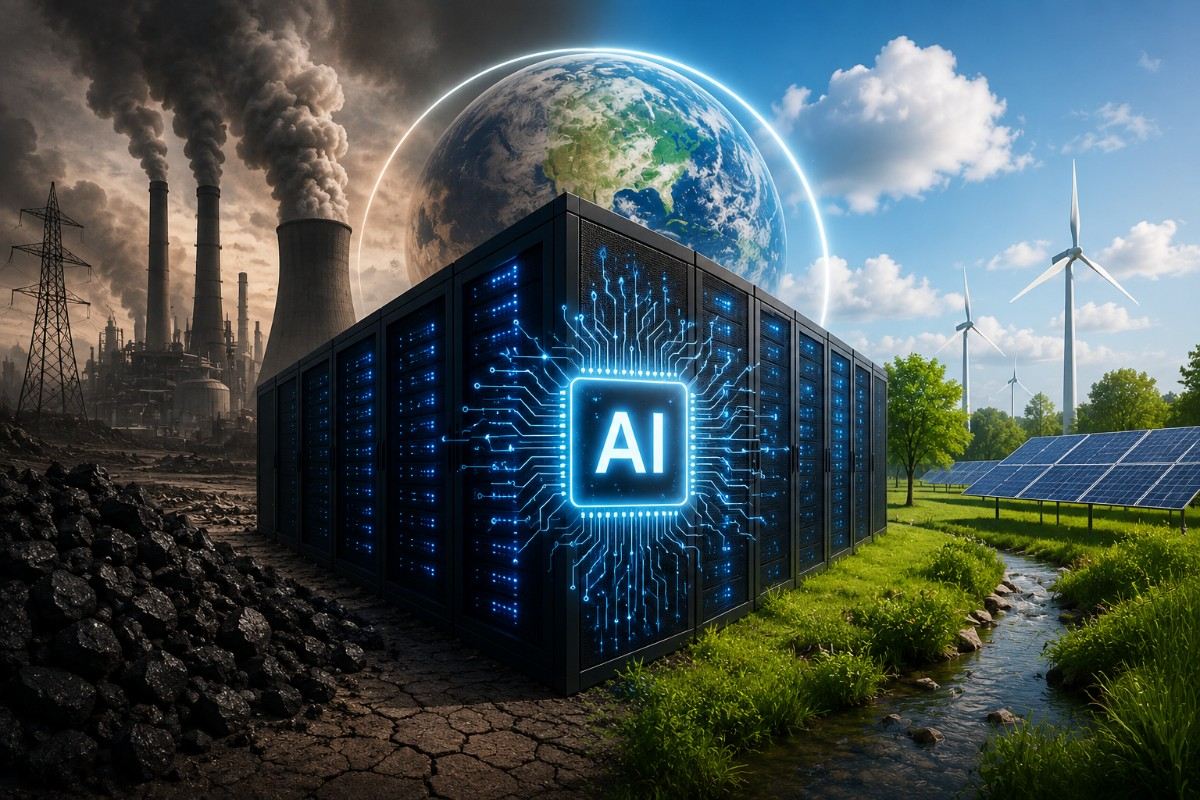
AI & SUSTAINABILITY
Can AI Ever Be Truly Green?
The $770 Billion Question Every Global Corporation Must Answer
JUNE 2026 · 2 MIN READ · SOURCES: PWC · FORRESTER · GARTNER · IDC · S&P GLOBAL
We love what AI can do. It optimises our supply chains, slashes inefficiencies, and promises a smarter, cleaner world. But here’s the uncomfortable truth sitting at the heart of every boardroom sustainability conversation right now: the technology we’re betting on to save the planet may be quietly burning it down.
| $770B Data centre capex in 2025 — surpassing upstream oil & gas S&P Global | 1.7Gt Annual CO₂ AI could add — 2–3% of global emissions Forrester | 14% of companies publicly reporting AI use for sustainability, PwC, Aug 2025 |
THE PROBLEM
The Scale Is No Longer Deniable
According to the International Energy Agency, electricity consumption from data centres and AI could double by 2026 — and PwC research confirms that data centres worldwide could consume as much electricity as the entire nation of Japan this year alone.
Forrester puts it bluntly: AI could add 1.3 to 1.7 gigatons of carbon emissions annually. And behind the headline figures, the picture is worse. Microsoft, despite pledging to be carbon negative by 2030, revealed its emissions increased by 29% since 2020, largely driven by data centre construction to support AI workloads.
The AI system that helps you write a report, generate an image, or analyse procurement data? It’s drawing from a grid that — in many regions — still runs on coal.

THE COUNTER-ARGUMENT
But the Story Has a Second Act
Here’s where it gets nuanced — and why supply chain and procurement leaders need to pay close attention.
Experts speaking at Procurement and Supply Chain LIVE made a compelling counterargument: AI doesn’t necessarily consume more resources than manual processes. It consumes them over a compressed timeframe, making the impact more visible and concentrated. The resources, they argue, would be used regardless.
Gartner predicts that by 2026, 50% of organisations will have adopted sustainability-enabled monitoring, so-called GreenOps, to manage energy consumption and carbon metrics across hybrid cloud. IDC forecasts that cloud adoption could prevent the emission of over 1 billion metric tons of CO₂ between 2021 and 2025.
PwC’s 2026 AI Business Predictions go further, suggesting AI’s overall effect on energy use and emissions could be neutral if companies deploy it strategically. The Sustainable Procurement Pledge community increasingly frames this as a “both/and” challenge: AI as both the problem and the most powerful tool we have to address it.
“In the long run, I believe there are definitely ways that we will move AI to being compatible with our lives and our planet.”
— DR ALYSON FREEMAN, DIRECTOR OF DATA CENTRE SUSTAINABILITY, DELL TECHNOLOGIES
POLICY & REGULATION
Regulation Is No Longer Optional — It’s Arriving Fast
In February 2026, the EU formally adopted the Omnibus I Package, revising the landmark CSRD and CSDDD. Companies with over 1,000 employees and €450M turnover must now disclose their environmental impacts — including those of their AI infrastructure- under standardised EU standards.
Gartner confirmed that carbon emissions are now a top-three criterion in cloud procurement decisions. The Carbon Border Adjustment Mechanism (CBAM) moved from reporting to full financial obligation in January 2026, meaning embedded emissions in supply chains now carry a direct cost.
New climate disclosure requirements are landing in Australia, Spain, and beyond, impacting US-based multinationals globally. As PwC’s State of Decarbonization 2026 report warns, only 14% of companies publicly report using AI to improve sustainability or emissions reporting. That gap is becoming harder to defend.
THE ACTION PLAN
What Global Companies Must Do Now
Gartner identifies four urgent actions for the AI–energy equation:
- Use AI to govern its own energy demand: Carbon-aware workload scheduling is table stakes, not innovation.
- Track and disclose AI-related emissions: Scope 2 and Scope 3 visibility is now a regulatory and commercial necessity.
- Right-size AI for actual business needs: Not every process needs a frontier model — efficiency is a sustainability strategy.
- Choose AI vendors on sustainability credentials: Procurement teams must embed this into supplier evaluation frameworks now.
THE VERDICT
Not Yet — But the Window Is Narrowing
Can AI ever be truly green? Not yet — but the trajectory is real.
The companies that treat AI sustainability as a compliance checkbox will find themselves on the wrong side of regulation, investor scrutiny, and customer trust within the next 24 months. Those who embed it into procurement strategy, supply chain governance, and technology decisions today will turn it into a competitive advantage.
The US data centre sector alone had contracted 50 GW of clean energy by the end of 2024. The path forward runs through honest accounting, ambitious renewable procurement, and regulation that forces the hand of those still dragging their feet.
The question is no longer whether to act. It’s whether you’re moving fast enough.
SOURCES
PwC State of Decarbonization 2026 · PwC 2026 AI Business Predictions · Forrester Environmental Sustainability 2026 · Gartner Top Strategic Technology Trends & Infrastructure & Operations 2026 · IDC FutureScape Worldwide Sustainability 2024 · S&P Global Data Centre Report 2025 · International Energy Agency · EU Omnibus I Directive (Feb 2026) / CSRD & CSDDD · Nature Sustainability (Nov 2025) · Procurement & Supply Chain LIVE · Sustainable Procurement Pledge